GEAR
UV printers that build real 3D objects
"UV printer that does 3D" means two different things. One prints ink onto a flat object and stacks it into relief (2.5D). The other builds the object itself out of cured ink. This article covers only the second kind.
Prices checked October–November 2026. Industrial machines are sold by quote, and crowdfunding prices differ from retail.
1. Two products, often confused
| UV surface printing (2.5D) | UV material jetting (3D) | |
|---|---|---|
| What it does | Ink on top of an object | Builds the object |
| Height | 5–7 mm relief | Tens to hundreds of mm |
| Examples | eufyMake E1, xTool O1 Omni | CJ270, 3DUJ, J55 Prime |
| Price | ~$2,400 | $4,500–$200,000 |
Both cure with UV light, but the output is entirely different. A surface printer cannot create a shape.
2. How it works
Photopolymer ink is jetted in very thin layers and cured by a UV lamp on each pass. Repeat thousands of times and you get a solid part. The trade names differ: material jetting, Stratasys PolyJet, Flashforge MJP.
- Layer height 7–28 µm — far thinner than FDM (100–200 µm)
- Colour CMYK + white + clear, mixed into hundreds of thousands to 10 million colours
- Support water-soluble, removed by soaking
- Materials 3–5 simultaneously (rigid, flexible, transparent)
3. The machines
| Model | Price | Build | Layer | Colour |
|---|---|---|---|---|
| Flashforge CJ270 | $4,499 | 180×120×100 mm | 7 µm | 10M+ |
| HeyGears G1X 3D Edition | $3,599 (KS) | 420×330×130 mm | — | 10M+ |
| Mimaki 3DUJ-2207 | $48,061 | 203×203×76 mm | 28 µm | 10M+ |
| Mimaki 3DUJ-553 | $216,211 | 508×508×305 mm | — | 10M+ |
| Stratasys J55 Prime | by quote | round 1,174 cm², 190 mm | 18.75 µm | ~640k, Pantone |
| Stratasys J35 Pro | by quote | round 1,174 cm² | 18.75 µm | no colour |
The J35 Pro is not full colour. Only the Prime line has Pantone colour. This is a common and expensive mix-up.
4. Desktop — Flashforge CJ270
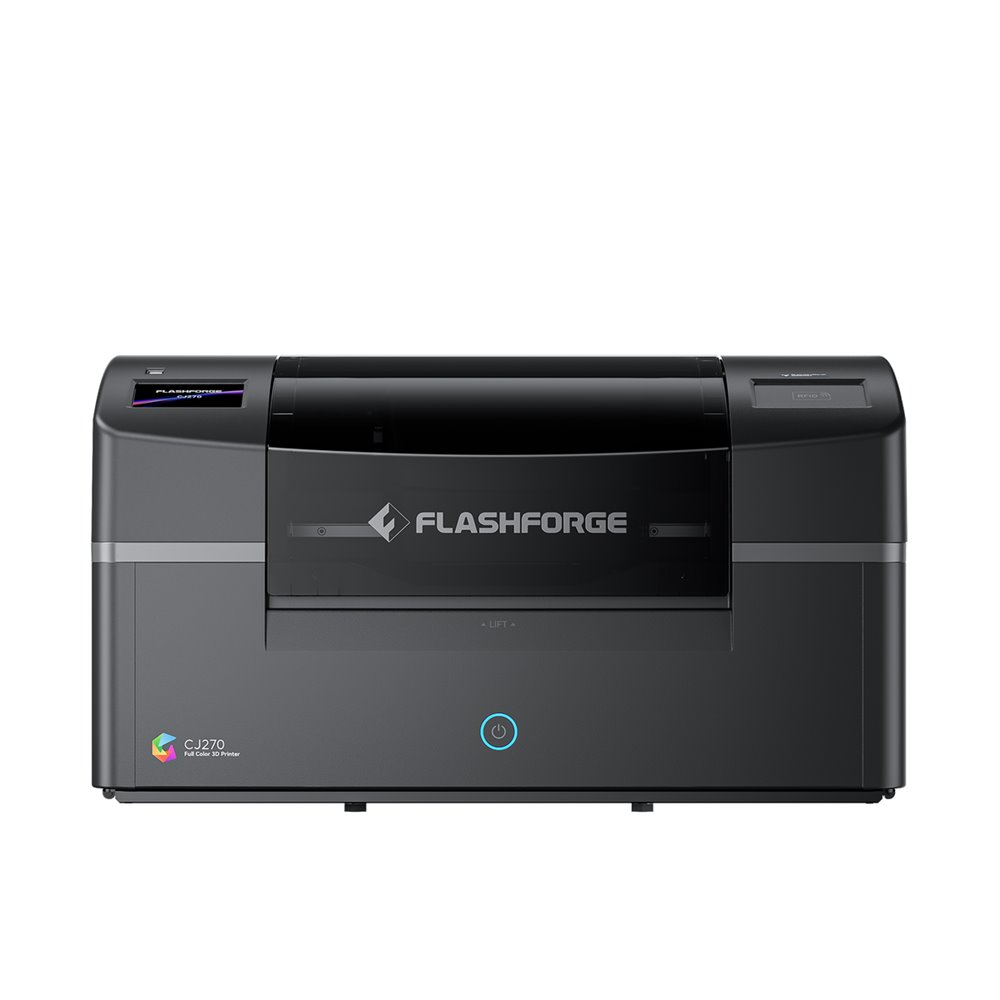
Marketed as the first desktop full-colour 3D printer. MJP process, 7 µm layers, 180×120×100 mm, 10 million colours.
- 697×410×405 mm · 33.5 kg · under 55 dB
- Heads replaceable individually, rated up to 2,000 hours
- Water-soluble support
Roughly a tenth of an industrial machine. Small build volume, and real-world reports are still scarce.
5. Hybrid — HeyGears G1X 3D Edition
One body, two configurations: UV Edition prints on surfaces, 3D Edition builds parts. The 3D Edition offers 420×330×130 mm and 10M+ colours.
The trap: buying the UV Edition and expecting 3D output.
6. Industrial — Mimaki 3DUJ-2207
| Build | 203×203×76 mm (3 kg max) |
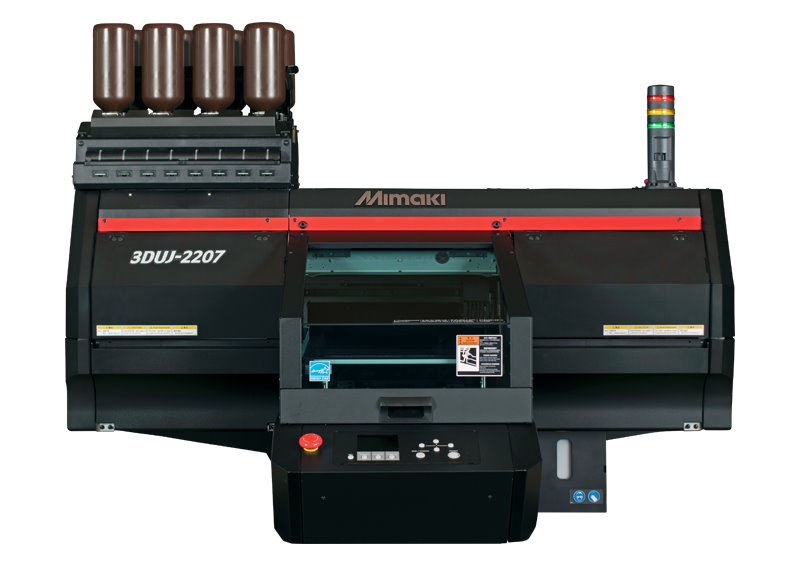
| Layer / resolution | 28 µm / 1200 dpi |
| Colour | 10M+ (CMYK, white, clear) |
| Support | Water-soluble |
| Size | 1,355×1,290×856 mm · 140 kg |
| Price | $48,061 MSRP |
Office-friendly in marketing, industrial in practice: 140 kg, dedicated floor space, and installation/training billed separately in some regions (about $7,000 in the US).
7. PolyJet — Stratasys J55 Prime
- Five materials at once — rigid, flexible, clear, ABS-like, tough
- ~640,000 colours with Pantone validation
- 18.75 µm layers, rotating round tray
- Under 53 dB with a built-in fume extractor
- 228 kg
Price is quote-only; Japanese dealers quote roughly ¥15–20 million. Consumables are expensive per kilogram, which makes it a design-validation tool rather than a parts machine.
8. What owners and reviewers say
Strengths
- No painting — colour is inside the material
- Very smooth surfaces — 7–28 µm layers are hard to feel
- Transparent plus flexible in one build — hard on FDM or resin alone
- Easy support removal — soak in water
Limits
- Strength — photopolymer is weak to heat and impact. Appearance, not function
- Material cost — PolyJet resins run hundreds of dollars per kg, 10–30× filament
- Speed — thousands of thin layers can be slower than FDM
- Maintenance — ink circulation and head care; long idle periods cause trouble
- Odour and handling — gloves with uncured resin
- Size limits — the 3DUJ-2207 tops out at 76 mm
Desktop machines released in 2026 still lack independent user data. Treat specs as manufacturer claims.
9. Compared with FDM and resin
| FDM | Resin | UV jetting | |
|---|---|---|---|
| Shape | ✅ large | ✅ precise | ✅ precise, small |
| Colour | single | single, painted | full colour |
| Surface | layer lines | smooth | smoothest |
| Strength | high | medium | low |
| Material cost | ~$20/kg | ~$100/kg | $300+/kg |
| Machine | $200+ | $300+ | $4,500+ |
Short version: FDM for shapes, resin for precision, UV jetting for colour and finish. None replaces another. See budget printers compared for the FDM side.
10. Checklist
- Is it really full colour? Sub-models often are not
- Build height — 76 mm or 190 mm changes what you can make
- Material price — consumables outrun the machine
- Support handling — water-soluble or extra equipment
- Installation — 140–228 kg, power, ventilation
- Service contract — industrial machines rarely run without one
- Local support — official distribution or import
11. Our view
Interpretation.
- Entry point for real UV 3D is around $4,500 (CJ270) — small build, thin data.
- For business, 3DUJ-2207 is the balance point: official distribution, installation, ~$48k.
- Colour-critical work needs PolyJet — five figures up front and expensive consumables.
- One machine cannot do everything. UV jetting is strong on appearance, weak on function.
Summary
A UV printer that builds real 3D is a machine for colour prototypes without painting. Structural parts still belong to FDM and resin. The $4,500 desktop machine opens the door, but 2026 is still an early year for it.
Sources
- Mimaki — 3DUJ-2207 specifications (2026)
- Mimaki USA — 3DUJ series MSRP
- Stratasys — J55 Prime
- Planet 3DP — J55 Prime specs (27 Oct 2026)
- SK Honpo — full-colour 3D vs UV comparison (Nov 2026)
- Images: Flashforge (CJ270) · Mimaki (3DUJ-2207)